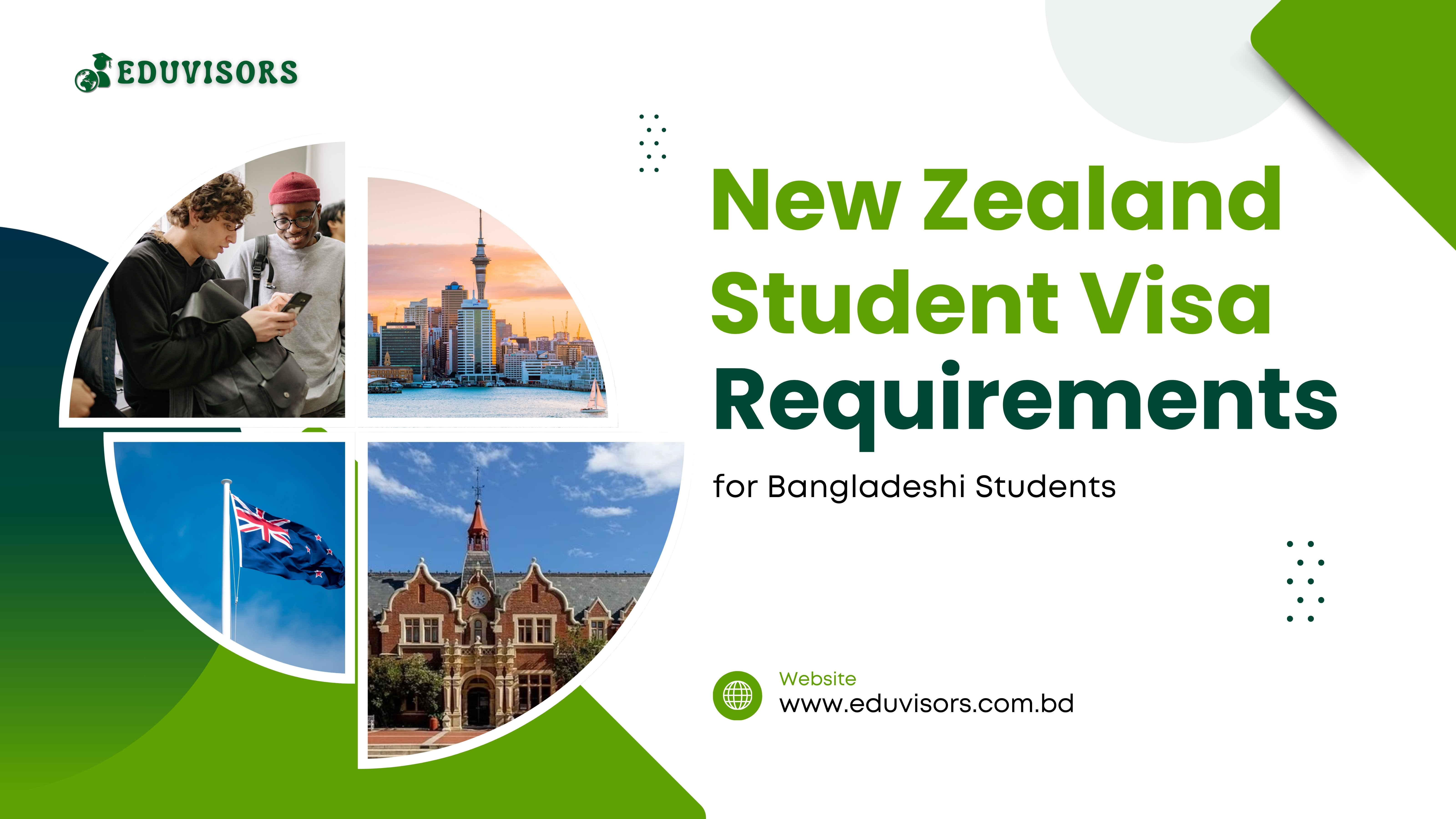
Introduction of New Zealand Visa Documentation for Bangladeshi Students
Studying in New Zealand is more than just a dream for many Bangladeshi students, it’s a significant step toward building a better future. New Zealand has grown to be a desirable option for students that are looking for both academic development and international experience due to its secure environment, excellent educational system, and excellent post-study work opportunities.
However, once you have received your offer letter, the next challenging phase will begin which is visa processing. In New Zealand, documentation is the most significant part of the visa application because it directly determines whether you receive your Approval in Principle (AIP), which is a conditional approval from immigration that confirms that your visa will be granted once you meet the final requirements, such as paying the fee or submitting additional documents.Unlike countries such as the UK, Australia, or Canada, in most cases there is no credibility interview in New Zealand. This means your documents must clearly and accurately reflect your genuine intentions, financial capacity, and academic background.This is where many students feel confused or overburdened, especially when it comes to preparing the required documents. Questions like “What documents do I actually need?” and “How should I organize them?””, or “Will a minor mistake lead to a rejection?” are quite common.
The truth is that most visa refusals occur not because students are unqualified, but because their documentation is insufficient or incorrectly presented. That is why it is important to completely understand the visa documentation process.
In the next section, we will break down all of the required documentation for Bangladeshi students to obtain a New Zealand student visa in a concise and practical way that will help you to prepare the documents confidently and avoid common mistakes.
Types of Student Visa for New Zealand
Before applying for a visa, it’s essential to be aware that New Zealand provides several types of student visas according to your study plan and funding. Choosing the appropriate visa category is necessary for a smooth application process.Below are the main types of student visas explained in a simple way.
Fee paying student visa
The majority of Bangladeshi students opt for this type of visa. This option is for you if you intend to study in New Zealand and pay your own tuition fees whether through family support, personal savings, or an education loan.It permits you to study full-time while also working part-time, which many students do to support living expenses or get work experience while studying.With this student visa, you may be allowed to work part-time for up to 25 hours a week, and full-time during mid-year study breaks and the holiday period. With this visa you can study full-time in New Zealand for up to 4 years.
This means that if you applied to a university and received an offer letter, this is likely the visa you will require.
Pathway student visa
This visa is for students who don’t immediately enroll in a bachelor’s or master’s program. For example, if you need to complete a foundation course, diploma, or English program before pursuing your main degree, this visa can cover multiple stages.Rather than requiring a new visa each time, you can stay in New Zealand for up to 5 years and progress through your studies on the same visa.
This is advantageous for students who do not meet direct entry requirements but still want a clear path to their desired degree.
Exchange or scholarship visa
Students who have been awarded a scholarship or who move to New Zealand as part of an official exchange program are eligible for this visa. You may be eligible for this visa, for example, if your university in Bangladesh has a partnership with a New Zealand institution or if you were awarded a government or university scholarship.The fact that the scholarship or exchange program usually covers all or part of your tuition fees is one of the main benefits of this visa. In specific circumstances, the visa can also make it feasible for you to receive additional help with living costs.You can apply for this visa to study full-time for up to 4 years.
This category is less common among Bangladeshi students because it relies on certain criteria or scholarship opportunities.
Which one is most common for Bangladeshi students
The Fee Paying Student Visa is the most popular choice for Bangladeshi students. Most students arrange their own funding and apply directly to New Zealand’s universities and institutions.So, if you’re doing everything on your own—from selecting a university to organizing your funds, that is the category you’ll most likely fall into.
Basic Eligibility Requirements
Before applying for a New Zealand student visa, be sure you satisfy the minimum eligibility criteria. Immigration New Zealand assesses applications primarily on the basis of your academic background, financial capacity, and genuine intention to study. Here’s an overview of the main requirements.
1. Academic Requirements
Meeting the academic requirements is an important part of getting a New Zealand student visa. Immigration New Zealand analyzes your educational background to ensure that you are properly prepared and qualified for the course you intend to pursue. This includes reviewing your previous qualifications, grades, and any specific subjects or criteria specified by your preferred program.
- Undergraduate programs require 12th/13th grade completion and at least 60-65% mark in HSC, or a recognized bachelor’s degree if applying for a Graduate Diploma.
A bachelor’s degree from a recognized Bangladeshi university with a grade point average of 70% or above is generally required for postgraduate programs.
2. English Language Proficiency
New Zealand educational institutions require proof of English proficiency, which is usually obtained through tests such as IELTS, PTE, or TOEFL. Your scores should meet the minimum requirements defined by your chosen institution to be eligible for admission and the student visa.
For undergraduate programs, students generally need an IELTS score of 6.0 overall (with no band below 5.5) or a PTE score of 50 overall (with no score below 42).
For postgraduate programs, a higher level is usually required—an IELTS score of 6.5 overall (with no band below 6.0) or a PTE score of 58 overall (with no score below 50).
N.B. A student may be exempted from the IELTS or English Language requirement for a New Zealand student visa if they have previously studied in an English-speaking country or at an institution where English was the primary medium of instruction.
3. Offer Letter from a Recognized Institution
You must have an unconditional admission offer from a New Zealand university, college, or institute that is authorized by Immigration New Zealand. Without this, you cannot begin the visa application procedure.
4. Proof of Financial Capacity
You must demonstrate that you can afford your tuition, living expenses, and travel expenses for the whole duration of your study in New Zealand. This could include personal funds, family support, or a sponsor. Immigration New Zealand strives to ensure that students are capable of supporting themselves financially without committing to unapproved employment while studying.
5. Health Requirement
Applicants for New Zealand student visas must submit a medical report, including a chest X-ray, from an Immigration New Zealand-approved Panel physician. The report must be no more than three months old at the time of submission. In Bangladesh, students can get their medical tests done at approved centers like IOM Migration Health Assessment Clinic (IOM MHAC) in Dhaka, Green Crescent Health Services in Dhaka, or Mercury Medical (previously Wahab Medical).
6. Character Requirement
As part of your New Zealand student visa application, you may be required to provide police certificates to demonstrate your good character. The certificate must be less than 6 months old at the time of application and is necessary for applicants aged 17 and above. If you have a criminal record or are considered a security risk, your visa may be refused.
7. Genuine intentions to study in New Zealand
You should clearly demonstrate that your primary intention in New Zealand is to study, and that you intend to return to your home country once you have completed your course. Proper paperwork and a strong visa application can help demonstrate this.
Meeting these fundamental requirements does not guarantee visa approval, but it is the first step towards a successful application.
Complete Document Checklist
To apply for a New Zealand student visa, you must submit all necessary documents showing your academics, finances, health, and genuine study intentions.
Required Documents
- Passport (all pages of old and new passport)
- Signed offer of Place from a New Zealand education provider
- All academics marksheets and certificates
- English Language Proficiency (IELTS PTE TOEFL)
- Complete set of work documents of Student (appointment letters, experience letter, promotion letters, salary slips, bank statement where the salary gets credited) (If any)
- Relationship Proofs Sponsors & Student (NID, Passport)
- Financial Affidavit of Sponsor
- Family Certificate
- Financial Documents
- Bank Statements and Solvency
- Sponsors Income documents
- Net worth certificate issued by a Chartered Accountant and should reflect value of assets in both currencies (BDT & NZ dollar)
- Digital Photograph – 45 mm height by 35 mm width (Size should be 381*528 pixels) (with face minimum 70% and maximum 80%) on non white but light colour background
Additional Requirements
- Police Clearance Certificate (Police certificates must be less than six months old when you submit your application)
- Chest X Ray Medical Report – Medical Reports from Panel Doctor – It should not be 3 Months Old
- Student declaration Form – INZ 1226
- Financial Undertaking form – INZ 1014
- Financial Matrix – A clear summary of required funds, available funds, and their sources
- Cover letter
- Statement of Purpose (SOP)
- Travel History (If any)
Funds Calculation for Bank Statement
When applying for a visa, you need to show sufficient funds to cover your tuition fees, living expenses, and travel costs.
Total Funds Required
Total Funds Required = Tuition Fee + Living Cost (1 year) + Travel Cost
- Tuition Fee: NZD XXX (as mentioned in your Offer Letter)
- Living Cost: NZD 20,000 per year
- Travel Cost: Approximately NZD 2,000
Bank Statement Requirements
- Official bank statements must show the account holder’s full name and include at least 3 months of recent transactions
- Savings accounts should have a minimum of 3 months transaction history to show financial stability (INZ can request for last 6 months if required)
- Any large deposit (over NZD 2,000) or multiple smaller deposits must be clearly explained with supporting documents
- Fixed deposits must show funds held for at least 3 months, including the deposit date and term details
Funding Options
Your funds for Tuition fees, living costs, and outward travel must be from a source that is genuine. They must be genuinely available for you to access while you are in New Zealand.
The funds you need can be covered by:
- money held by you or on your behalf
- an acceptable sponsor
- a guarantor or third party
Sponsorship Guarantor
Only 1 sponsor or financial guarantor is permitted. INZ may only accept a financial guarantor immediate family member (wife or husband, parents, brothers, sisters). It may vary case to case.
The sponsor must provide clear evidence of their source of income and financial capacity to support the student.
Evidence of Funds
- bank statements and Solvency, including the name of the account holder and the last 3 months of transaction history
- fixed term deposit certificates Receipt showing that the term deposits have been held for at least 3 months
- evidence of provident funds that can be withdrawn at any time
Source of Income of Sponsor Supporting Documents
If the sponsor is employed
- Most recent TIN Tax Return Certificate
- Payslips of at least last 6 months
- Employer letter confirming position and income
- Employment contract Appointment Joining Letter
- 6 months salary bank statements
- Company ID Visiting Card
If the sponsor is a business owner
- Business registration documents Trade License
- Business letter (on company letterhead)
- Most recent business TIN Tax Return Certificate
- Business audit report
- Bank statements of business account (6 months)
- Invoices Sales records
Proof of Additional Income
If you are showing rental income as part of your financial support, you should provide:
- Rental Agreement
- Rental payment slips receipts or bank statements showing rental deposits
Source of Fund of Sponsor
To demonstrate the source of funds, sponsors may provide evidence from the following acceptable sources:
- Sale of Land – Supported by sale deed, registration documents, and bank transaction proof
- Sale of Agricultural Crops – Acceptable with proper receipts, invoices
- Sale of Assets (Flat) – Supported by ownership documents, sale agreement, and proof of payment received
- Business Income – Profits from a registered business. Supported by trade license, business registration, TIN tax returns, audit reports, bank statements
Important Note
If your bank account shows large deposits (over NZD $2,000), or many smaller ones, explain where the money came from and include supporting documents.